Road and earthworks measure
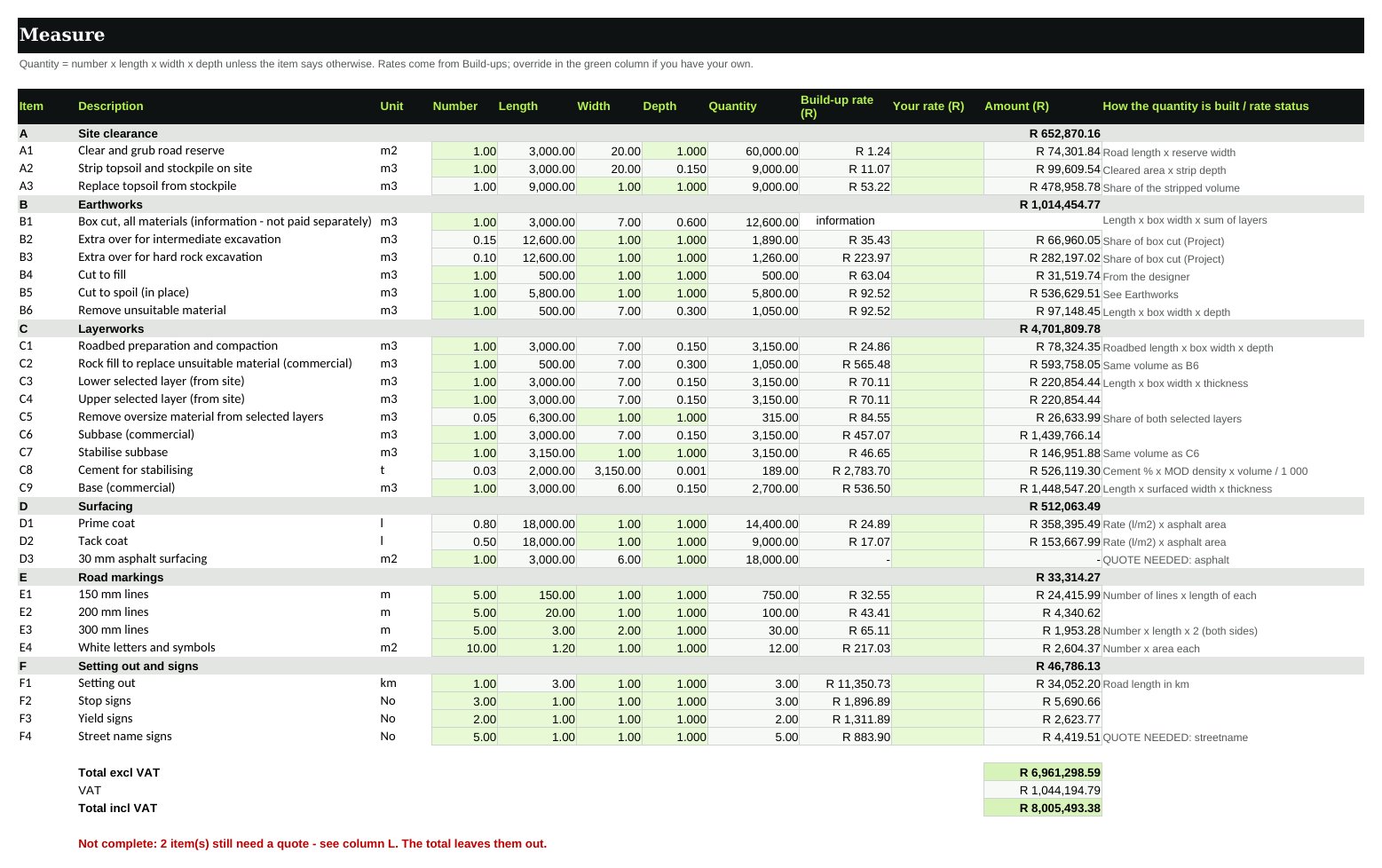
Measure a new road from a handful of dimensions: clearance, box cut and excavation classes, the cut and fill balance with bulking, every pavement layer, the binders, the asphalt and the markings.
Who it is for: Estimators pricing municipal and township roads, and contractors checking a bill of quantities before they tender.
Free · version 1 · 19/10/2026 · opens in Excel and Google Sheets
What it calculates
- Clear and grub, topsoil strip and replacement
- Box cut from the sum of the layer thicknesses, with intermediate and hard rock as shares of it
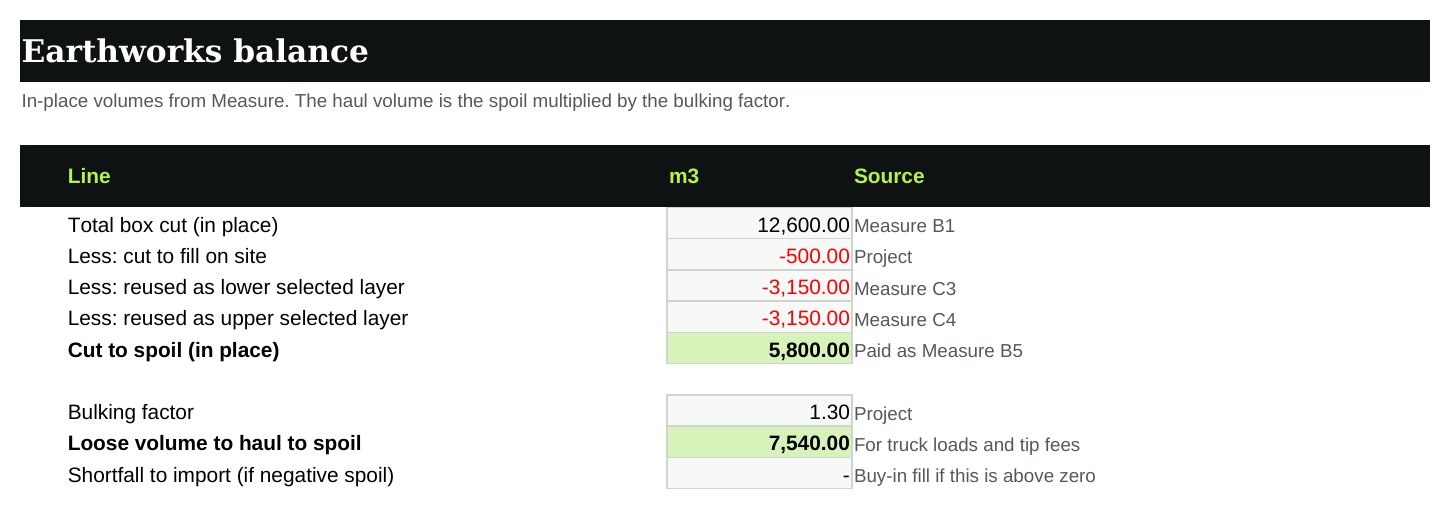
- Cut to fill, reuse in the selected layers, spoil in place and the loose volume to haul
- Roadbed, selected layers, subbase, stabilising cement in tons and base
- Prime and tack in litres, asphalt in m², road markings and signs
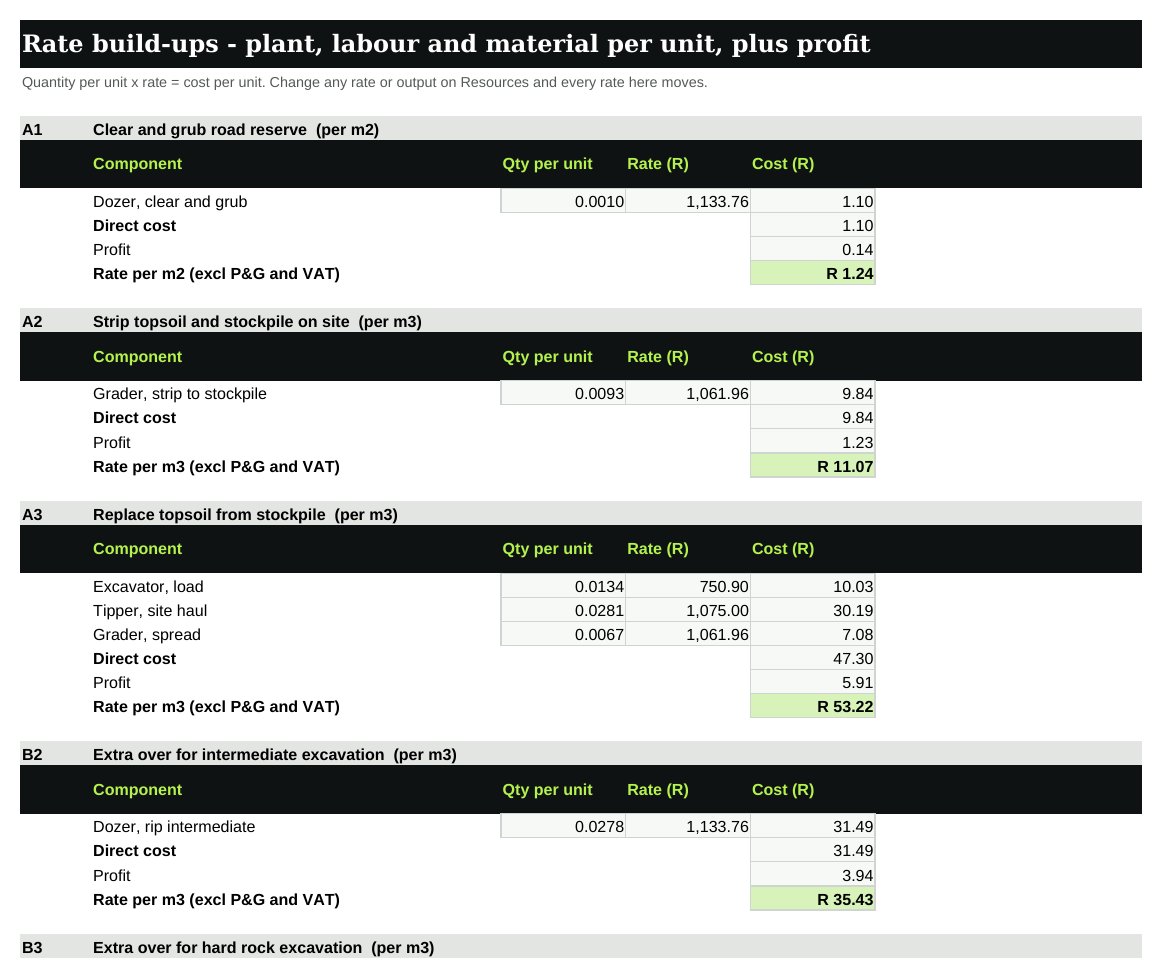
- A built-up rate for every item: plant hours from a cited output × hire rate plus diesel, labour, material and 12.5% profit
How to measure it, step by step
- 01
Enter the road dimensions
On Project, enter the road length, the road reserve width, the surfaced width and the box-cut width (the surfaced width plus the shoulders).
Why: Nearly every road quantity is length × width × depth. Four dimensions drive the whole measure, so a change to the alignment moves every line at once.
- 02
Enter the layer thicknesses
Enter each pavement layer's thickness from the pavement design: lower and upper selected, subbase, base, and the depth of roadbed treatment.
Why: The box cut is the sum of the layers. Excavation, layer volumes and spoil all follow from these numbers. The source template typed the box-cut volume in instead, so it never moved.
- 03
Split the excavation by class
From the geotechnical report, enter the share of the box cut expected in intermediate material and in hard rock.
Why: Hard material is paid at several times the rate of soft, so the split moves the price more than the volume does. Until there is a report, these are assumptions. The workbook labels them as such so nobody mistakes them for measurements.
- 04
Set the bulking factor for haul
Enter the ratio of loose to in-place volume for the material you will cart away. For soil, 1.25 to 1.35 is common. Rock bulks more.
Why: Excavation is measured in place, but trucks carry loose material. The Earthworks sheet multiplies the spoil by this factor, so truck loads and tip fees are priced on the volume that actually has to leave site. The loose volume is for your costing, not the bill: SANS 1200 ME pays overhaul beyond the 2 km free haul on the designed volume with no allowance for bulking (clauses 8.1 and 8.3.9).
- 05
Enter the stabilising and binder rates
Enter the cement content of the stabilised layer, its MOD (maximum dry) density, and the prime and tack application rates in litres per square metre.
Why: Cement is ordered by the ton and binders by the litre. Both are a rate applied to a layer quantity: cement = cement % × MOD density × volume.
- 06
Check the built-up rates
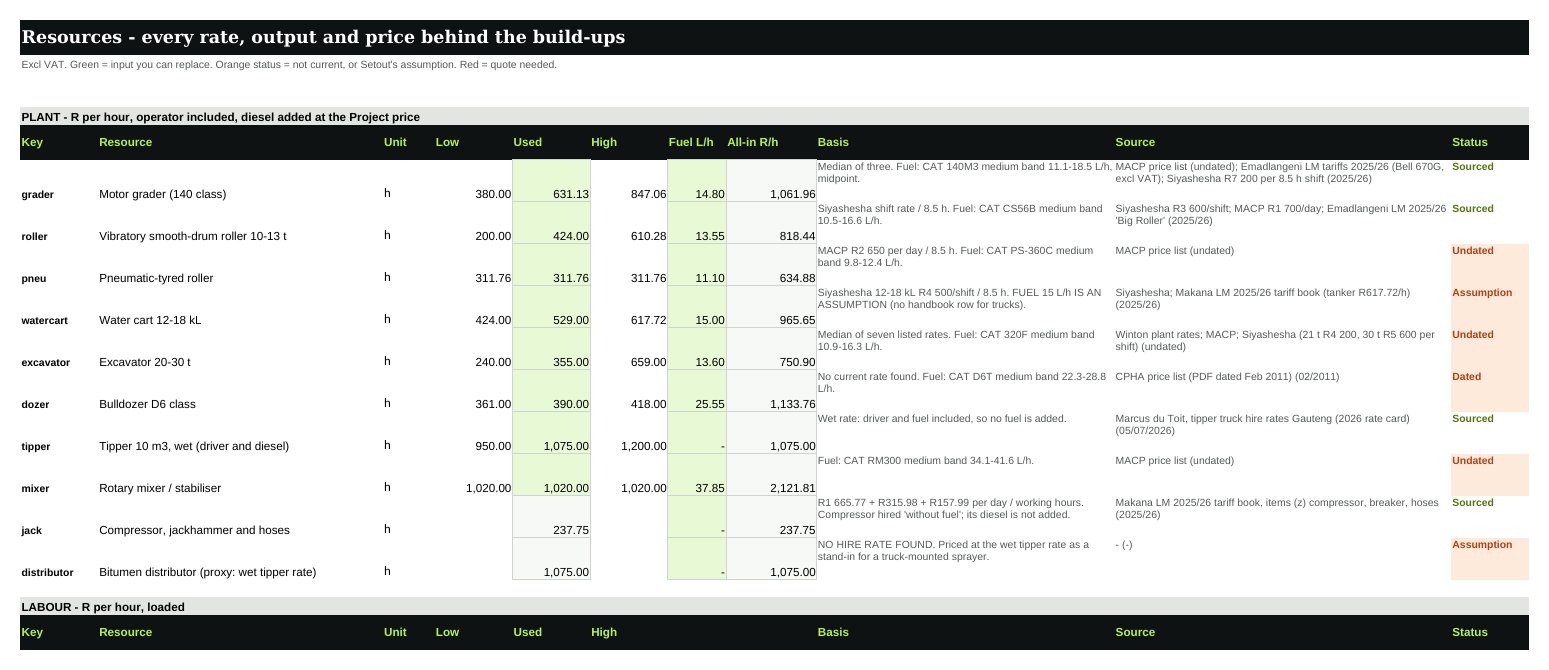
Each rate on Measure comes from Build-ups, which works from Resources. Plant hours are one over a cited output, times the hire rate plus diesel at the Project price. Labour and material are added, then profit. Read the status column on Resources: orange marks a rate that is undated, from an old document, or Setout's assumption. Replace any of those you have better figures for. To use a rate of your own, type it in the green 'Your rate' column on Measure.
Why: A rate you can trace is a rate you can defend at a tender clarification. The orange cells show exactly where the evidence is thin, so you know which numbers to check first.
- 07
Get the two quotes the workbook cannot give you
Asphalt surfacing (D3) and street name signs (F4) carry a red QUOTE NEEDED flag. Enter an asphalt subcontract rate and a sign supplier's price on Resources.
Why: No South African price for either could be found in any published source, and inventing one would put a guess under the biggest surfacing item. Until you enter them, Measure leaves both out of the total and says so under it.
- 08
Read the totals and the balance
Measure totals each section and adds VAT. Earthworks shows cut, reuse, spoil and any shortfall to import.
Why: The balance tells you whether you are buying fill or paying to dump spoil, before either surprises you on site.
Screenshots
Measuring rules
- Measure in place
- Layer volumes are measured to the finished shapes, sections and profiles on the drawings. Material placed outside the specified lines and levels is not paid unless the engineer ordered it in writing (SANS 1200 ME, clause 8.2, applied to the base by MF clause 8.2.1). Bulking and compaction factors belong in the rate, not in the measured quantity.
- A commercial-source layer is one all-in rate
- Subbase and base from a commercial source are paid per m³. The rate covers finding the source, buying the material, carting it to the road, spreading, watering, compacting, grading, tolerances and testing. No extra is paid for excavation class, processing or overhaul unless the project specification says so (SANS 1200 ME, clauses 8.1(d) and 8.3.3; MF clause 8.3.3).
- Stabilising is two items
- The stabilising process is paid per m³ of layer, and the rate excludes the stabilising agent. The cement or lime is paid per ton, measured as the quantity the engineer ordered or the quantity actually incorporated, whichever is less (SANS 1200 ME, clauses 8.3.5(d) and 8.3.8). That is why the workbook has C7 and C8 as separate lines.
- Use the specification the tender names
- SANRAL has let its work on the COTO 2020 Standard Specifications since 1 March 2021. Many municipal and provincial tenders still name COLTO 1998 or SANS 1200. Their payment items and units differ, so match the measure to the document in the tender.
- Excavation classes
- Soft, intermediate and hard rock are the classes most bills use. Take the shares from the geotechnical report. Where the bill pays them as extra over the general excavation, as here, the box cut itself carries no rate.
- How the rates are built
- Outputs come from the India MoRTH Standard Data Book (2019), whose plant figures are about 70% of rated output, and from the Caterpillar Performance Handbook 49. Hire rates are 2025/26 municipal tariffs and published plant-hire lists. Labour and most materials come from the Setout rate library (09/2026). These are first-principles estimates, not tendered rates, and they exclude P&G and VAT. The dozer rate dates from 2011 and the water-cart fuel and distributor rate are Setout's assumptions; all three are flagged.
Standards behind it
Measure to the document your contract names. Clause numbers are given only for the SANS parts read in full, and the wording is paraphrased: read the clause itself in your copy. Each card says how far that reference was checked.
COTO Standard Specifications for Road and Bridge Works for South African Road Authorities (2020)
Materials and construction of earthworks and pavement layers (Chapters 4 and 5) and asphalt layers (Chapter 9), each with new measurement and payment items.
In this workbook: Use it when the tender names COTO. SANRAL made it mandatory for tenders advertised from 1 March 2021.
Reference checked Status and chapter split per the South African Road Federation. Payment item numbers not checked: confirm in your copy.
COLTO Standard Specifications for Road and Bridge Works for State Road Authorities (1998)
The earlier road specification that COTO replaces. Some provincial and municipal tenders still name it.
In this workbook: Same layer logic as here. Its payment items and units differ from COTO.
Confirm in your copy Not read. Confirm in your copy.
SANS 1200 ME, Subbase (SABS 1200 ME-1981)
Subbase and gravel wearing course for roads, shoulders, footways and paved areas, including measurement for payment.
In this workbook: Volumes to the finished shapes on the drawings (8.2). Commercial-source subbase is one all-in rate per m³ (8.3.3). Stabilising is paid per m³ without the agent (8.3.5(d)), and the agent per ton at the lesser of the ordered and the incorporated quantity (8.3.8). Free haul is 2 km, and overhaul is paid on the designed volume with no bulking (8.1(c), 8.3.9).
Reference checked Clause 8 read in the 1981 edition (approved 20/05/1981). If your contract names a later edition, check the clause numbers against it.
SANS 1200 MF, Base (SABS 1200 MF-1981)
Base for roads, shoulders, footways and paved areas: gravel, graded crushed stone, crushed stone with soil fines and waterbound macadam.
In this workbook: Measurement follows ME clause 8.2 (MF 8.2.1). Base from a commercial source is billed per m³ by material type: gravel, graded crushed stone, or crushed stone with soil fines (8.3.3). Stabilising, the agent and overhaul follow ME (8.3.5, 8.3.8, 8.3.9).
Reference checked Clause 8 read in the 1981 edition (approved 20/05/1981).
SANS 1200 D, DM, MH and MM
Earthworks, earthworks for roads (subgrade), asphalt base and surfacing, and ancillary roadworks.
In this workbook: The excavation classes, cut to spoil, roadbed, selected layers, asphalt and markings in this workbook fall under these parts.
Confirm in your copy Not read. Setout holds ME and MF only. Confirm the classes and items in your copy.
SANS 2001 series, Construction works
Construction standards meant to replace SANS 1200. They do not contain measurement and payment.
In this workbook: Where a contract uses SANS 2001, measurement comes from the bill's own preambles.
Confirm in your copy SABS decided in 2012 to withdraw SANS 1200 once SANS 2001 was complete (CSIR presentation); the current status is not confirmed.
More on which standard applies when: measuring standards for South African construction.
What we fixed in the source template
This workbook is rebuilt from a contractor template that was in use. These are the errors it carried, and what each does now.
- Total cut (12 600 m³) and the two selected layers (3 150 m³ each) were typed in, so they did not move when the road changed. They now link to the dimensions.
- The roadbed length was typed as 2 500 m on a 3 000 m road. It now follows the road length unless you override it on purpose.
- The amount column had no total. Measure now has section totals, VAT and a grand total.
- Spoil had no bulking factor, so the haul volume was understated. Earthworks now gives the loose volume.
- The excavation percentages sat in the quantity column. They are now labelled assumptions on Project.
Planning-stage quantities, not a final account or a quote. Check every quantity against the drawings and the bill’s preambles. General guidance, not professional or engineering advice.
Reviewed by Aidan Koetaan MBA PMP, quantity surveyor and construction project manager.
The Setout list
New calculators, by email
One email when we add a calculator or re-price the rate library. No spam, unsubscribe anytime.
Want a second pair of eyes on your takeoff before you tender? [email protected]