Rebar schedule and tonnage
Turn a bending schedule into reinforcement tonnage. Enter bar marks, numbers and cut lengths, and get mass per bar mark and tonnes by bar type and diameter. Every bar mass is calculated from its diameter, not typed in.
Who it is for: QSs measuring reinforcement from the engineer's schedule, and contractors checking a steel supplier's delivered tonnage.
Free · version 1 · 19/10/2026 · opens in Excel and Google Sheets
What it calculates
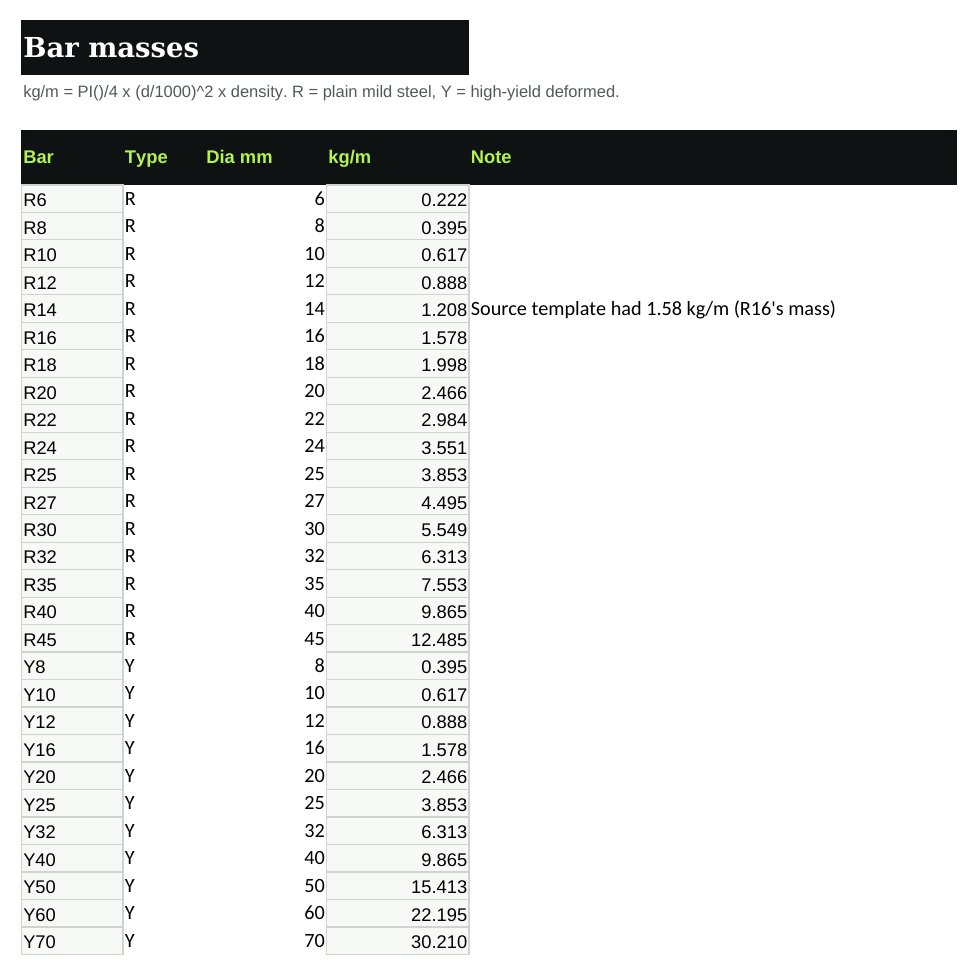
- Mass per metre for R6 to R45 and Y8 to Y70: π/4 × d² × 7 850 kg/m³
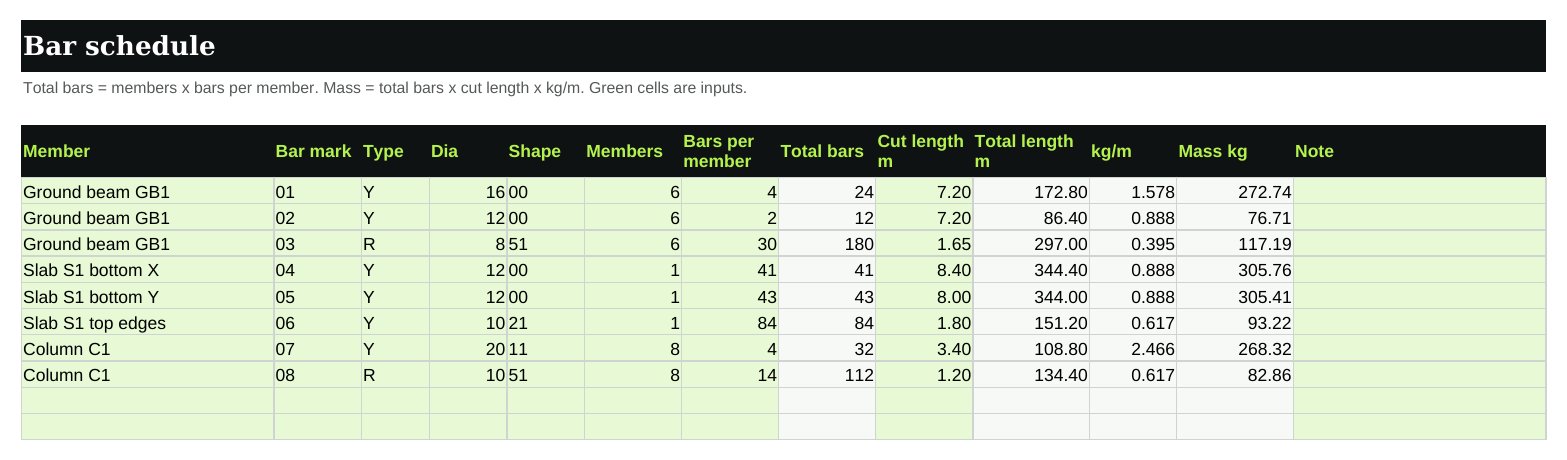
- Total bars = members × bars per member, and total length = bars × cut length
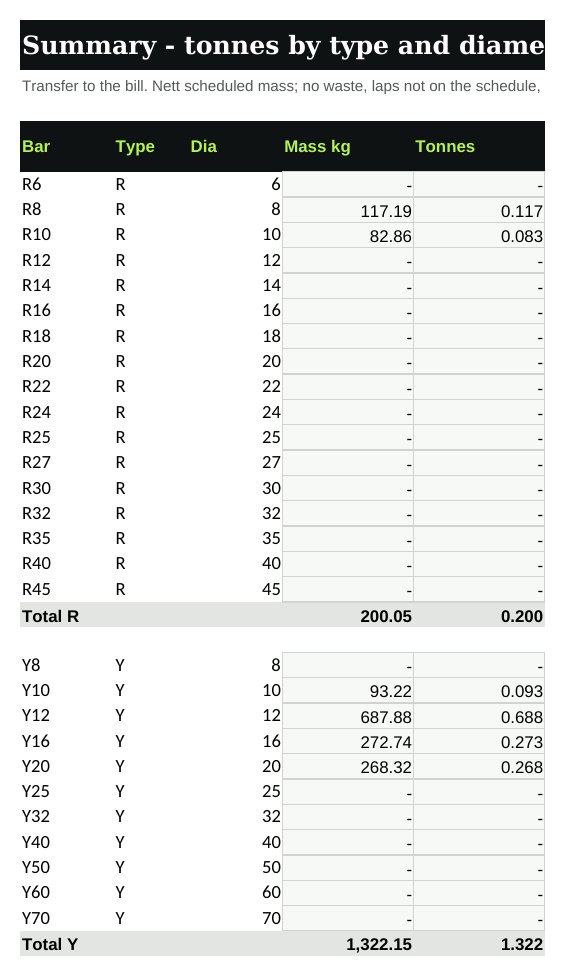
- Mass per bar mark and tonnes by type and diameter
- A check that every scheduled kilogram reached the summary
How to measure it, step by step
- 01
Record the schedule and its revision
On Project, enter the structure, the schedule number and its revision.
Why: Reinforcement tonnage changes with every schedule revision. A printout that does not say which revision it measured cannot be checked later.
- 02
Copy one line per bar mark
On Schedule, enter each bar mark from the engineer's bending schedule: member, bar mark, type (R or Y), diameter and shape code.
Why: The bar mark is the unit the engineer, the bender and the QS all share. A line per mark lets anyone check the tonnage against the schedule, line by line.
- 03
Enter members and bars per member separately
Enter the number of identical members and the number of this bar in each one. The sheet multiplies them.
Why: Ten identical beams with six bars each is 60 bars. Keeping the two numbers apart makes the line easy to check against the drawing and easy to change when a member is added.
- 04
Use the cut length from the schedule
Enter the cut length in metres as the bending schedule gives it. It already includes the bends and hooks.
Why: Reinforcement is measured by the mass of bars as scheduled. The cut length is what the bender cuts and the supplier delivers, so it is the length to measure.
- 05
Read tonnes by type and diameter
Summary gives kg and tonnes for each R and Y size, a total for each type, and the overall total. The check line compares it with the schedule total.
Why: Bills price reinforcement per tonne, often by diameter range, because small bars cost more per tonne to cut and bend. A non-zero unmatched figure means a type or diameter on the schedule is not in the bar table.
Screenshots
Measuring rules
- Measure the scheduled mass
- Measure the bars as scheduled. Do not add for laps the schedule does not show, tying wire, chairs, spacers, waste or rolling margin. Check the preambles for which of these the rate is deemed to include.
- How bar masses are worked out
- Mass per metre = π/4 × d² × 7 850 kg/m³. That gives 0.888 kg/m for Y12 and 1.578 kg/m for Y16, the nominal values in reinforcing-bar tables. If your contract names SANS 920, check its table.
- Shape codes for traceability
- Record the shape code from the engineer's schedule, which follows SANS 282. The code does not change the mass. It is there so the line can be traced back to the schedule.
Standards behind it
Measure to the document your contract names. Clause numbers are given only for the SANS parts read in full, and the wording is paraphrased: read the clause itself in your copy. Each card says how far that reference was checked.
SANS 920, Steel bars for concrete reinforcement
Bar types, grades, sizes and nominal masses of reinforcing bar.
In this workbook: Bar masses are calculated at 7 850 kg/m³, the basis of the nominal mass tables.
Confirm in your copy Not read (SABS paywall). Confirm the mass table in your copy.
SANS 282, Bending dimensions and scheduling of steel reinforcement for concrete
Shape codes, bending dimensions and how bar schedules are set out.
In this workbook: The shape code is recorded per bar mark. Cut lengths come from the engineer's schedule.
Confirm in your copy Not read (SABS paywall). Confirm in your copy.
SANS 1200 G, Concrete (structural)
Concrete work on civil engineering contracts, including the measurement of reinforcement.
In this workbook: Reinforcement measured by mass from the schedule and billed in tonnes by type and diameter.
Confirm in your copy Not read (SABS paywall). Confirm the measurement clause in your copy.
ASAQS Standard System of Measuring Building Work, 7th edition (2015)
How building work is measured and billed in South Africa.
In this workbook: Measure nett quantities as drawn and leave waste, laps and fixing to the rate unless the preambles say otherwise.
Reference checked Edition and release date (1 October 2015) per ASAQS. Read the trade clauses in your copy.
More on which standard applies when: measuring standards for South African construction.
What we fixed in the source template
This workbook is rebuilt from a contractor template that was in use. These are the errors it carried, and what each does now.
- R14 carried 1.58 kg/m, the mass of R16. The correct nominal mass is 1.208 kg/m, so every R14 bar was overstated by 31%.
- The totals block linked most sizes from R27 upward to the wrong column: R32 showed R27's tonnage and Y16 showed R32's. R30 was missing altogether.
- Totals summed rows 18 to 10 000 while the sheet ran to row 12 636, so anything below row 10 000 was dropped.
- The original file was 6.7 MB of copied formulas. It is now under 70 KB, with SUMIFS totals over the full schedule.
Planning-stage quantities, not a final account or a quote. Check every quantity against the drawings and the bill’s preambles. General guidance, not professional or engineering advice.
Reviewed by Aidan Koetaan MBA PMP, quantity surveyor and construction project manager.
The Setout list
New calculators, by email
One email when we add a calculator or re-price the rate library. No spam, unsubscribe anytime.
Want a second pair of eyes on your takeoff before you tender? [email protected]